
Blogs
When Is Back or Neck Pain Serious? Warning Signs You Shouldn’t Ignore
Most back and neck pain resolves on its own. But some don’t – and knowing the difference matters more than most people realize.
When is back pain serious? That question is worth answering clearly, because the wrong answer in either direction causes real problems. Dismiss something serious, and a manageable condition becomes a chronic one. Panic over something minor, and nothing useful gets done.
This guide gives you a practical, honest framework for reading your own symptoms.
Is Your Pain Normal or a Sign of Something More Serious?
Pain has a language. Learning to read it helps you respond appropriately rather than guessing.
Acute pain – from a sudden strain, overexertion, or awkward movement – typically behaves predictably: it peaks early, then gradually improves with rest and gentle movement. Most cases clear within days to a few weeks.
Chronic or nerve-related pain behaves differently. It lingers. It travels. It may feel sharp, burning, or electric – and it often doesn’t improve with the usual remedies. When worsening back pain symptoms don’t follow the normal recovery arc, that pattern itself is clinically meaningful.
7 Warning Signs Your Back or Neck Pain May Be Serious
Pain That Keeps Getting Worse Instead of Better
Normal pain improves over days. Pain that consistently worsens – week over week, not just hour to hour – suggests an underlying structural issue that isn’t self-correcting. This trajectory is one of the most reliable indicators that evaluation is needed.
Pain That Radiates to the Arms or Legs
Radiating pain that travels from the neck into the shoulder and arm, or from the low back into the hip and leg, is typically nerve-related. The pain isn’t originating where you feel it – it’s being generated at a compressed nerve root in the spine and traveling along the nerve pathway.
Numbness, Tingling, or “Pins and Needles”
Numbness and tingling in the hands, fingers, feet, or toes are classic signs of nerve compression or irritation. These sensations mean the nerve’s ability to communicate normally is being disrupted – not just strained.
Sharp, Shooting, or Burning Pain
A dull ache suggests muscle involvement. Sharp, shooting, or burning quality strongly suggests nerve pain. The distinction matters for treatment and for urgency.
Weakness in the Arms or Legs
Muscle weakness that develops alongside back or neck pain – difficulty gripping, reduced leg strength, or altered coordination – indicates that motor nerve function is being affected. This raises the clinical priority level considerably.
Pain That Disrupts Sleep or Occurs at Rest
Mechanical back pain typically improves with rest. Pain that wakes you at night, persists regardless of position, or is worse lying down can suggest inflammatory conditions, significant nerve involvement, or causes that need medical evaluation.
Pain After an Injury or Accident That Doesn’t Improve
Post-trauma pain that hasn’t meaningfully improved within 1–2 weeks warrants clinical assessment. Adrenaline masks injury immediately after impact; soft tissue and disc injuries often peak 24–72 hours later and can persist without proper evaluation.
Red Flags That Require Immediate Medical Attention
These symptoms should not wait for a scheduled appointment – go to an emergency room:
- Loss of coordination or balance – sudden, unexplained
- Loss of bladder or bowel control
- Progressive arm or leg weakness happening over hours or days
- Severe, sudden pain without a clear cause
- Numbness spreading beyond its original area
These can indicate serious neurological involvement, including cauda equina syndrome. Don’t wait.
When Should You See a Chiropractor for Back or Neck Pain?
Outside of emergencies, these are the clearest signals that a professional evaluation is the right next step:
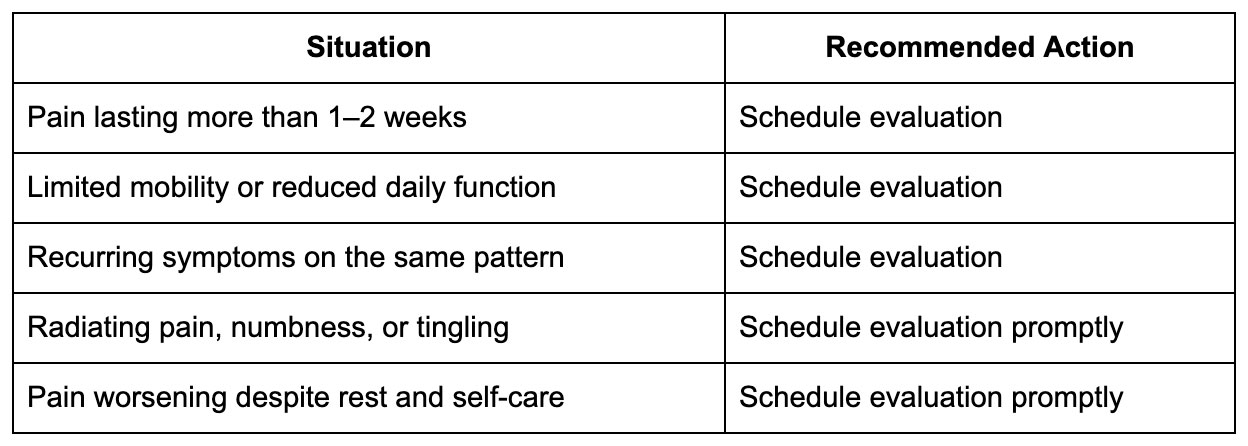
The earlier structural issues are identified and addressed, the more straightforward the care – and the better the long-term outcome.
How Chiropractic Care Helps Identify the Root Cause
Symptoms are signals, not diagnoses. Pain in the shoulder may come from the neck. Leg pain may originate in the lumbar spine. Treating where it hurts without identifying where it’s coming from is one of the most common reasons people stay in pain longer than necessary.
Chiropractic care begins with a structural evaluation of the spine – the most common source of both back pain and nerve-related symptoms throughout the body. When vertebrae are misaligned, discs are compressed, or nerve roots are irritated, symptoms appear far from the actual source.
A study by Dr. Paul Shekelle, published in Annals of Internal Medicine, confirmed that spinal manipulation produces clinically meaningful improvement in acute and subacute low back pain – with an effect comparable to or better than conventional medical care for appropriate cases.
What You Can Do Right Now If Your Pain Is Getting Worse
If symptoms are escalating, here’s a practical framework:
Monitor briefly if:
- Pain began within the last 48–72 hours following identifiable activity
- Symptoms are not worsening and don’t include neurological signs
Act sooner if:
- Pain has been present for more than 1–2 weeks
- Symptoms include radiating pain, numbness, tingling, or weakness
- Daily activities – work, sleep, movement – are noticeably affected
In the meantime:
- Avoid prolonged positions that aggravate symptoms
- Gentle movement is generally better than complete rest for mechanical pain
- Document when symptoms are better or worse – this information is clinically useful
Conclusion: Don’t Ignore the Warning Signs
Pain is a signal. It doesn’t always mean something serious – but it always means something. The question when is back pain serious doesn’t have a one-size answer, but the patterns above give you a reliable framework for deciding when to act.
If your pain is getting worse, not improving, or including symptoms like radiating pain, numbness, or nerve involvement – it may be time to have it properly evaluated. A spinal assessment identifies the root cause before it becomes a bigger, harder-to-resolve problem.
At Abundant Life Clinic of Chiropractic, Dr. Maudeline Newell brings a careful, patient-centered approach to back and neck pain evaluation. As your trusted chiropractor New Castle, we’ll take the time to understand your symptoms, examine what’s driving them, and build a clear, personalized path forward.
Schedule your spinal assessment today and get the clarity your pain has been asking for.
This article is educational and does not replace a professional evaluation.

Are you looking for a great family chiropractor in New Castle?
Contact us for a FREE consultation: 765-388-2525
Abundant Life Clinic
of Chiropractic
1220 Church Street
New Castle, IN 47362
765-388-2525
Office Hours
Mon ∙ Tue ∙ Wed
8:30am – 1pm & 3pm – 6pm
Thu ∙ Fri ∙ Sat ∙ Sunday
Closed