Blogs
Can a Herniated Disc Heal Naturally? What You Need to Know
You’ve just been told you have a herniated disc. Your first thought: Do I need surgery?
The fear is immediate. The uncertainty is real. But here’s what you need to know: many people recover from herniated discs without surgery. Most people, actually. Understanding why helps you move from fear to realistic hope.
This guide explains what a herniated disc is, what recovery looks like, and what matters for healing – without surgery.
Quick Answer: Can Herniated Discs Heal Without Surgery?
Yes. Most herniated discs heal naturally without surgery.
Here’s the reassuring part: Research shows that 80-90% of herniated discs improve significantly within 3-6 months using conservative care. Surgery becomes necessary in only a small percentage of cases.
However and this matters – “healing” doesn’t mean the disc physically returns to its original state. It means symptoms resolve and you return to normal function. The disc may retain a slight bulge, but you won’t be affected by it.
Understanding What a Herniated Disc Actually Is
Before discussing healing, understanding the anatomy helps.
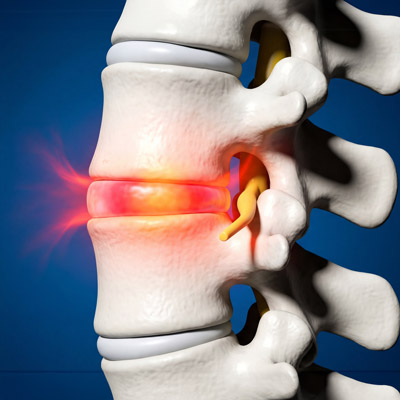
Your spine consists of vertebrae stacked on top of each other. Between each vertebra sits a disc – a cushion with a soft inner core and tough outer shell. These discs absorb shock and allow movement.
A herniated disc means: The inner core has leaked through a crack in the outer shell. This leakage can irritate nearby nerves, causing pain, numbness, or tingling.
Common names for the same condition:
- Herniated disc
- Slipped disc
- Ruptured disc
- Protruding disc
Despite the scary names, they’re describing the same mechanical problem—disc material extending beyond its normal boundary.
Why Most Herniated Discs Heal Naturally
Here’s the encouraging part: your body has remarkable healing ability.
Several processes work toward recovery:
Inflammation decreases. The initial inflammatory response causes significant pain and symptoms. Over weeks and months, this inflammation naturally subsides. As inflammation decreases, symptoms decrease.
Reabsorption occurs. The body gradually reabsorbs the leaked disc material. This process varies in speed, but it happens naturally. Imaging studies show that many bulges shrink or even disappear completely over time.
Nerves become less irritated. As inflammation decreases and swelling reduces, nerve irritation resolves. Even if disc material remains, it irritates the nerve less.
You adapt. Your body develops compensatory patterns, strengthens surrounding muscles, and adapts to the new structure. This adaptation supports healing and stability.
This isn’t metaphorical healing – it’s actual physiological recovery. Your body does this automatically, but several factors influence how well and how quickly.
Factors That Support Natural Healing
Recovery speed varies based on multiple factors.
Movement (appropriate, not complete rest). Counter-intuitively, movement speeds healing. Complete bed rest actually slows recovery. Gentle, appropriate movement increases blood flow, promotes healing, and prevents muscle deconditioning.
Inflammation management. Reducing inflammation accelerates healing. This includes appropriate medication, ice/heat, and activity modification – avoiding activities that repeatedly irritate the nerve.
Core strength. Weak core muscles allow excessive spinal movement, repeatedly irritating the disc. Strengthening your core stabilizes the spine and supports healing.
Posture and ergonomics. Poor posture and ergonomics create cumulative stress on the disc. Improving these reduces repeated irritation.
Stress management. Chronic stress increases inflammation and tension, both slowing healing. Stress reduction supports recovery.
Smoking status. Smoking impairs blood circulation and slows healing. If you smoke, quitting accelerates recovery significantly.
Age. Younger people typically heal faster than older people, though age doesn’t prevent healing.
Compliance with treatment. Recovery requires consistency. Those who follow treatment recommendations and activity modifications heal faster.
Multiple factors influence recovery. Addressing them collectively accelerates healing.
Timeline: How Long Does Healing Take?
Recovery isn’t instant, but it’s often faster than expected.
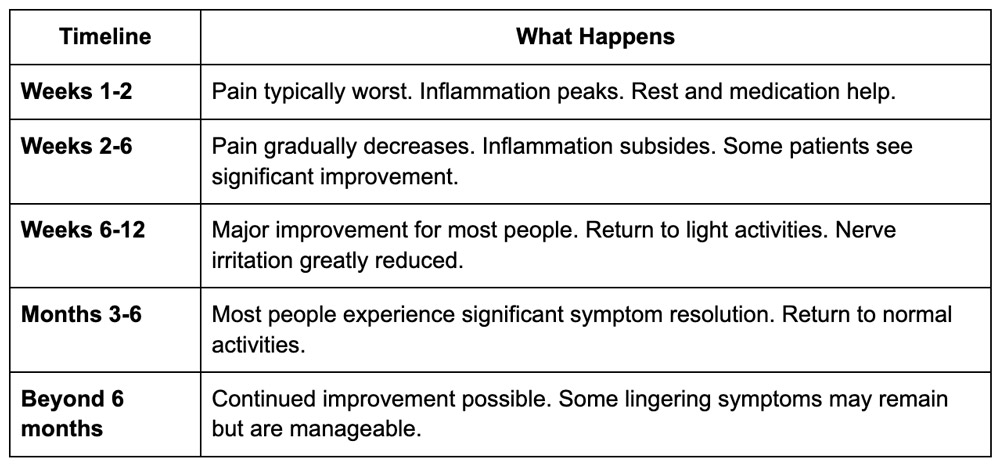
Important caveat: This is a general timeline. Individual recovery varies significantly. Some people improve faster. Others take longer. The severity of the initial herniation, your age, and your compliance all influence the timeline.
Most people experience meaningful improvement within 3-6 months. Complete resolution sometimes takes longer, but significant progress happens relatively quickly.
Warning Signs: When You Might Need More Than Conservative Care
While most herniated discs heal naturally, certain signs warrant urgent medical evaluation.
Seek immediate medical attention if you experience:
- Sudden severe neurological symptoms – rapidly worsening numbness or weakness in both legs
- Loss of bowel or bladder control – sudden inability to control these functions
- Severe progressive weakness – muscles rapidly getting weaker
- Fever accompanying spine pain – suggests possible infection
- Severe unrelenting pain unresponsive to conservative care after 6-8 weeks
- Progressive nerve damage despite weeks of conservative care
These signs suggest complications requiring medical evaluation and possibly surgical intervention. However, they’re relatively rare. Most people won’t experience these.
Symptoms During Healing: What’s Normal?
Many patients worry that lingering symptoms mean healing isn’t happening.
Understanding what’s normal helps:
Symptoms fluctuate. Healing isn’t linear. You might feel significantly better one day, worse the next. This is normal. Overall trend matters more than day-to-day variation.
Some symptoms linger longer. Pain often improves first. Numbness and tingling sometimes take longer to fully resolve – occasionally weeks or months longer. This is normal and doesn’t indicate healing failure.
Certain activities temporarily increase symptoms. This doesn’t mean you’re damaging yourself. It means you’ve overdone it slightly. Rest and pain management address this. The next day is usually better.
Healing isn’t visible. You can’t see disc reabsorption or nerve recovery on X-rays immediately. Just because imaging doesn’t change doesn’t mean healing isn’t happening.
Understanding these patterns prevents unnecessary panic and keeps you focused on recovery.
What Conservative Care Looks Like
Most people recover using conservative (non-surgical) approaches.
Common conservative strategies:
Activity modification – avoiding positions or activities that aggravate symptoms. Most important initial step.
Pain management – medication (often NSAIDs) reducing inflammation and pain, making movement tolerable.
Physical therapy or chiropractic care – specific exercises strengthening core muscles and improving spinal mechanics.
Posture and ergonomics – adjusting your workstation, sleeping position, and daily habits to reduce disc stress.
Ice and heat – ice reducing acute inflammation, heat soothing muscle tension.
Time – healing happens naturally. Sometimes patience is the most important treatment.
Most people use a combination of these approaches. Recovery comes from addressing multiple factors simultaneously.
In New Castle and surrounding areas, many patients find chiropractic care – combined with exercises and activity modification – helpful during recovery. The key is finding an approach supporting your natural healing process.
What Not to Do (Common Mistakes Slowing Recovery)
Avoid these recovery-delaying patterns:
- Complete rest beyond 1-2 days – immobility weakens muscles and slows healing
- Ignoring symptoms and pushing through – aggravating the disc repeatedly delays recovery
- Poor posture or ergonomics – creates continued stress on the disc
- Smoking – impairs circulation and slows healing significantly
- Chronic stress without management – increases inflammation
- Excessive heavy lifting – repeatedly irritates the healing disc
- Neglecting core strengthening – leaves spine unstable and vulnerable
Awareness of these mistakes helps you avoid them.
Moving Forward: Your Recovery Path
A herniated disc diagnosis feels serious and it is. But the reassuring reality is that most people recover naturally without surgery.
Recovery requires patience, consistency, and appropriate care. It’s not instant, but meaningful improvement typically happens within weeks to months.
Your path forward might include rest, medication, physical therapy, chiropractic care, posture improvement, or a combination. The right approach depends on your specific situation.
If you have a herniated disc diagnosis and want to explore conservative care options in the New Castle area, Dr. Maudeline Newell at Abundant Life Clinic of Chiropractic can help you understand your options. We’re here to discuss your situation and help you understand your options.
Contact Abundant Life Clinic of Chiropractic now!
This article is educational and does not replace professional medical advice. Always consult your physician about your specific diagnosis and treatment options.
References:
- Chiu, C. C., et al. (2015). “Herniated nucleus pulposus. Natural history, pathophysiology, and non-operative treatment.” Journal of Spine Surgery, 1(1), 61–68.
- Valat, J. P., et al. (2006). “Sciatica.” Best Practice & Research Clinical Rheumatology, 24(2), 241–252.
- Saal, J. S., et al. (1990). “Nonoperative management of herniated nucleus pulposus with radiculopathy.” Spine, 15(6), 671–678.
Are you looking for a great family chiropractor in New Castle?
Contact us for a FREE consultation: 765-388-2525
Abundant Life Clinic
of Chiropractic
1220 Church Street
New Castle, IN 47362
765-388-2525
Office Hours
Mon ∙ Tue ∙ Wed
8:30am – 1pm & 3pm – 6pm
Thu ∙ Fri ∙ Sat ∙ Sunday
Closed